
You check your fermenter and notice that the airlock has stopped bubbling. Is your beer ready, or has fermentation stalled?
This is one of the most common concerns among homebrewers, especially beginners. The good news is that a stopped airlock does not necessarily mean fermentation has stopped. Fermentation can slow down naturally, and small leaks in the fermenter can allow carbon dioxide to escape without passing through the airlock.
Before adding more yeast or changing anything, take a moment to check what is happening. Here are seven possible causes of stalled or apparently stopped fermentation, along with practical steps you can take to protect your beer.
1. Fermentation Is Already Complete
The simplest explanation is that your yeast has finished most or all of its work.
During fermentation, yeast consumes fermentable sugars and produces alcohol and carbon dioxide. As the available sugars decrease, fermentation slows down and eventually stops.
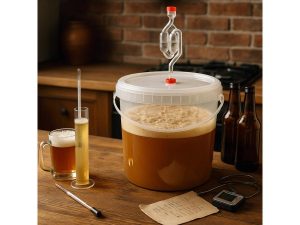
Depending on the yeast strain, recipe, temperature and original gravity, vigorous fermentation may last only a few days. However, the beer may need additional time for the yeast to finish fermenting and clean up some fermentation by-products.
Measure the beer’s specific gravity with a hydrometer or a properly calibrated refractometer. If the gravity remains stable across readings taken 48–72 hours apart and is consistent with the expected final gravity, fermentation is likely complete.
Do not rely on the airlock alone to decide when to bottle.
2. The Fermentation Temperature Is Too Low
Yeast needs a suitable temperature range to remain active. If the temperature falls below the range recommended for your yeast strain, fermentation may slow down considerably or stop temporarily.
This can happen when the room gets colder overnight, the fermenter is moved to a cool basement, or the temperature drops after the initial vigorous fermentation.
How to fix it
- Check the temperature of the beer itself, if possible, rather than relying only on the room temperature.
- Compare the reading with the recommended range for your yeast strain.
- If the beer is too cold, gradually bring it back into the appropriate range.
- Give the yeast time to become active again.
Avoid sudden temperature changes or excessive heating. Warmer is not always better: temperatures above the yeast’s recommended range can produce unwanted flavours.
3. The Fermentation Temperature Is Too High
High temperatures can also cause problems. Some yeast strains ferment quickly at warmer temperatures, but excessive heat can stress the yeast and create unwanted flavours, such as harsh alcohol notes or excessive fruity or solvent-like aromas.
In addition, fermentation generates heat. The beer inside a fermenter can become warmer than the surrounding room, especially during vigorous fermentation.
How to fix it
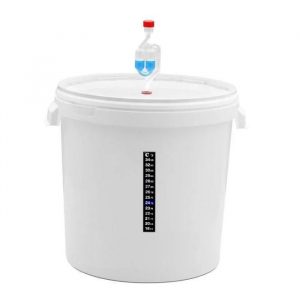
Check the recommended temperature range for your yeast and monitor the beer’s temperature. If it is too warm, move the fermenter to a cooler, stable environment or use a suitable temperature-control method.
Do not cool the beer abruptly. Gradual adjustments are generally safer for the yeast and the beer.
4. The Fermenter Is Not Airtight
An airlock is useful because it lets carbon dioxide escape while limiting the entry of outside air. However, it is not a reliable fermentation meter.
If the lid, gasket, bung or airlock seal leaks, carbon dioxide may escape through another opening. The airlock may show little or no activity even while fermentation continues normally.
How to check
Look for obvious problems with the lid, bung and airlock assembly. Do not open the fermenter unnecessarily just to look for bubbles.
Instead, measure the specific gravity. If the gravity is decreasing, fermentation is still taking place, regardless of what the airlock shows.
5. The Yeast Was Old, Damaged or Not Used Correctly
Yeast health matters. Old yeast, poorly stored yeast or yeast exposed to unsuitable conditions may have lower viability and struggle to start fermentation.
Other problems can occur if the yeast is used outside the manufacturer’s instructions. Some dry yeast products can be sprinkled directly onto the wort, while others may benefit from rehydration under specified conditions.
How to prevent this
- Check the expiry date and storage instructions.
- Use the correct amount of yeast for your batch size and original gravity.
- Follow the manufacturer’s instructions for pitching or rehydration.
- Avoid exposing yeast to extreme temperatures.
If fermentation has genuinely stalled, first confirm that the gravity is no longer decreasing and check the temperature. Adding more yeast without identifying the cause may not solve the problem.
6. The Wort Had Too Much Sugar for the Yeast
A high original gravity means the wort contains a relatively large amount of dissolved extract. High-gravity beers can be more demanding on yeast because of the increased osmotic stress at the start of fermentation and the rising alcohol concentration as fermentation progresses.
If the yeast quantity was too low or the strain was not suitable for the recipe, fermentation may stop before reaching the expected final gravity.
What should you do?
Check your original gravity, expected final gravity and yeast manufacturer’s recommendations. Also consider whether the yeast strain is suitable for the beer style and alcohol level you are aiming for.
Do not assume that every beer must reach the same final gravity. Different recipes and yeast strains produce different results.
7. The Yeast Needs More Time or the Beer Has a Different Final Gravity Than Expected
Not every beer follows the same fermentation schedule. Yeast strains differ in their activity, attenuation and tendency to settle out of suspension. Recipe composition also matters: some sugars are not fermentable by ordinary brewing yeast.
A beer may therefore finish at a higher final gravity than expected without fermentation being stuck.
What should you do?
Take gravity readings over time and compare the results with the recipe and yeast specifications. If gravity is stable but higher than expected, investigate the recipe, mash temperature if applicable, extract composition and yeast characteristics before attempting to restart fermentation.
If gravity is still decreasing, allow the beer more time.
How to Tell Whether Fermentation Has Really Stopped
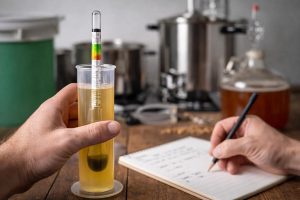
The most reliable practical method is to measure specific gravity rather than counting airlock bubbles.
Follow these steps:
- Take a gravity reading. Use a clean, sanitised sampling method and a suitable measuring instrument.
- Record the result. Note the date and, if possible, the beer temperature.
- Wait 48–72 hours. Keep the beer within the yeast’s recommended temperature range.
- Take another reading. Use the same measurement method and account for temperature where necessary.
- Compare the results. A continuing drop indicates that fermentation is still progressing. Stable readings suggest fermentation may be complete, although a stable reading above the expected final gravity may warrant further investigation.
If you use a refractometer, remember that alcohol affects its reading after fermentation begins. You will need an appropriate correction method to estimate the true final gravity.
You can also use an ABV calculator to estimate the beer’s alcohol content from the original and final gravity readings.
Should You Add More Yeast?
Not immediately.
Before adding more yeast, check the beer’s temperature, take gravity readings and review the recipe. If the beer has reached its expected final gravity and the readings are stable, additional yeast is usually unnecessary.
If fermentation is genuinely stuck, the solution depends on the cause. Correcting a low temperature may be enough. Other situations may require a suitable fresh yeast culture or specialist advice, especially for high-gravity beers.
Avoid adding sugar simply to make fermentation restart. Doing so can increase the potential alcohol level and may create additional problems if the underlying cause remains unresolved.
Is It Safe to Bottle the Beer?
Do not bottle beer just because the airlock has stopped bubbling.
If fermentation is incomplete, yeast may continue consuming fermentable sugars in the bottle. The resulting carbon dioxide can cause excessive carbonation and, in severe cases, bottles may break under pressure.
Before bottling, confirm that gravity readings are stable over several days and that the result makes sense for your recipe. Stable gravity is important, but it should not be treated as proof of safety if the reading is unexpectedly high or other signs of a problem remain.
When in doubt, wait and investigate rather than risk overcarbonated bottles.
Final Thoughts
A homebrew that appears to have stopped fermenting is not necessarily ruined. The airlock may have stopped bubbling because fermentation is complete, the fermenter is leaking carbon dioxide, or the yeast is working more slowly than expected.
Measure specific gravity, check the temperature and give the yeast enough time. These simple steps will help you make a better decision than relying on bubbles alone.
With a little patience and accurate measurements, you can avoid unnecessary interventions and give your beer the best chance of turning out well.
Happy brewing!
Leave a Reply
You must be logged in to post a comment.