
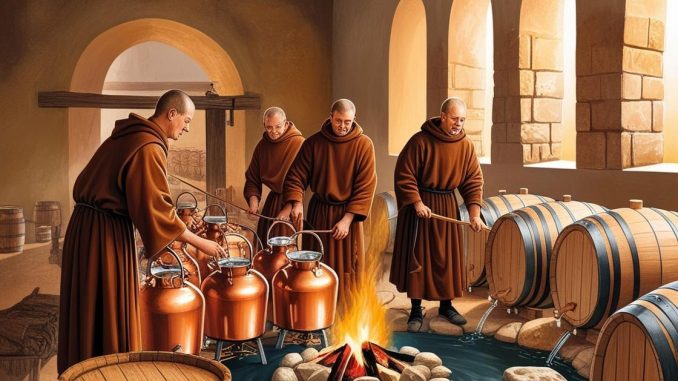
When we think about beer, we usually imagine breweries, malt, hops, fermentation tanks and perhaps a friendly pub.
But centuries ago, some of Europe’s most important brewing centres were hidden behind the walls of monasteries.
Monks brewed beer for their own communities, welcomed travellers and pilgrims with it, and gradually developed a reputation for producing excellent drinks. Their knowledge of agriculture, ingredients and fermentation helped shape brewing traditions that are still alive today.
Some of the world’s most famous beers even carry the names of the monasteries where their stories began.
So how did monks become such an important part of beer history?
Let’s find out.
1. Why Did Monks Brew Beer in the First Place?
Medieval monasteries were largely self-sufficient communities. Monks grew crops, baked bread, raised animals and produced many of the things they needed for everyday life.
Beer naturally became part of this routine.
Brewing was a practical way to use grain, and beer could provide nourishment and calories. It was also served to guests, travellers and pilgrims visiting monasteries.
In an age when access to safe drinking water could be uncertain, fermented drinks were an established part of everyday life. However, it would be misleading to say that everyone drank beer because water was unsafe: people drank water too.
Monasteries also had something that many ordinary households did not: organised facilities, agricultural resources and people who could dedicate time to developing their brewing skills.
Over generations, this helped some monastic breweries become particularly respected.
2. Monasteries Helped Develop Brewing Knowledge 
Monks were not the first people to brew beer. Humans had been making fermented grain drinks thousands of years before medieval monasteries appeared.
But monasteries became important centres of organised brewing in Europe.
Their communities could grow barley, prepare malt, manage ingredients and repeat brewing processes on a larger scale than many households.
The famous ninth-century Plan of Saint Gall, an architectural drawing of an ideal monastery, even included three separate breweries.
This tells us something about how important brewing was considered within monastic life.
Monastic brewers also helped develop and preserve practical knowledge about ingredients and production. Their experience became part of the wider European brewing tradition.
3. The Story of Hops and the Monasteries
Imagine modern beer without hops.
It would be a very different world.
Hops contribute bitterness, aroma and flavour, but they also help beer keep for longer.
Their use in brewing developed gradually over centuries. Monastic communities played a role in the cultivation and use of hops in parts of medieval Europe.
One particularly interesting historical figure was Hildegard of Bingen, a twelfth-century abbess, writer and natural philosopher.
In her writings, she discussed hops and recognised their ability to help preserve beverages.
She did not invent the use of hops, but her observations are an important part of the written history of brewing.
For modern homebrewers, this is a fascinating reminder that one of our most familiar brewing ingredients has a long and complicated history.
4. The Birth of the Trappist Brewing Tradition

If there is one name that immediately connects monasteries with beer, it is Trappist.
The Trappists are a branch of the Cistercian religious order, following a tradition of prayer, simplicity and work.
Their approach is often summed up by the Latin expression Ora et Labora — pray and work.
Some Trappist monasteries developed breweries as a way to support their communities and finance charitable activities.
Over time, their beers became internationally respected for their quality and distinctive character.
However, there is something important to understand: not every beer made by a monastery is automatically Trappist beer.
The name Trappist is protected, and the International Trappist Association sets strict conditions for its use.
For a beer to carry the Authentic Trappist Product label:
- It must be produced within the immediate surroundings of the monastery.
- Production must take place under the supervision of the monastic community.
- The profits must support the monastery, the Trappist community or charitable and development projects.
This means that Trappist beer is not simply a style of beer. It is also a guarantee of origin and a connection to a living monastic community.
5. Famous Trappist Beers That Still Carry the Tradition
Several monasteries have become famous among beer enthusiasts around the world.
Here are a few names worth knowing.
Westvleteren — Belgium
<escape>Westvleteren</escape> is one of the best-known names in the world of Trappist beer.
The monks of Saint Sixtus Abbey began brewing in the nineteenth century. Their first official brew dates to June 1839.
The brewery has remained closely connected to the monastic community, and its beers have gained an almost legendary reputation among enthusiasts.
Westmalle — Belgium
Westmalle is particularly important in the history of Belgian beer.
Its brewery has a long tradition, and its Tripel is often associated with the development and popularisation of the Belgian Tripel style.
The brewery continues to operate under monastic supervision, combining modern equipment with a strong connection to its abbey.
Rochefort — Belgium
The monks of Rochefort Abbey produce beers known for their rich malt character and complex flavours.
Rochefort’s beers are especially popular among people who enjoy strong Belgian ales.
Chimay — Belgium
Chimay is another internationally recognised Trappist name.
Its brewery was established at Scourmont Abbey in the nineteenth century. Today, Chimay beers are enjoyed around the world, while the brewery remains connected to the abbey and its charitable mission.
6. Monks, Beer and the Art of Patience
There is something interesting about the connection between monastic life and brewing.
Both require patience, routine and attention to detail.
A monk follows a structured daily rhythm. A brewer follows a carefully managed production process.
Neither can simply demand that the desired result appear immediately.
Fermentation takes time. Ingredients need to be selected carefully. Conditions must be controlled, and the finished beer must be given the opportunity to develop.
Of course, modern breweries have technology that medieval monks could never have imagined.
But the basic principles of brewing remain surprisingly familiar.
Perhaps that is one reason why the story of monastic brewing still appeals to modern craft brewers and homebrewers.
7. Are Monastery Beers Still Relevant Today? 
Absolutely.
Monastic breweries continue to produce beers that attract attention from enthusiasts, collectors and ordinary beer drinkers.
Some breweries have modernised their equipment and production facilities, while maintaining the traditions and supervision of their monastic communities.
Others have had to adapt to changing circumstances, including fewer members of their communities and the practical challenges of running a brewery.
The important thing is that the tradition has not simply become a museum exhibit.
It is still part of the living world of beer.
And for anyone interested in brewing history, that is something worth celebrating.
A Tradition That Survived Centuries
Monks did not invent beer, and they were certainly not the only people responsible for its development.
But their contribution to European brewing history is difficult to ignore.
They helped establish organised brewing centres, cultivated ingredients, developed practical knowledge and created traditions that continue to inspire brewers today.
The next time you see a bottle of Trappist beer, remember that you are looking at more than just another beer label.
You are seeing a small part of a history that stretches back centuries.
Have you ever tried a Trappist beer? Which one would you recommend to another beer enthusiast?
Share your experience in the comments!
Leave a Reply
You must be logged in to post a comment.